Train travel in India is a necessity for almost every Indian because not every city in India has an airport connectivity whereas Indian Railways, being one of the largest rail networks in the world, connects even the remotest locations in the country. Train travel, being cheaper than both road and air travel, is the lifeline of the nation. Moreover, in my personal opinion, nothing can beat the comfort of a train journey where you can sip a cup of tea and have a long chat with your loved ones while looking at the scenic landscape through the window. To do all these things, the only thing that you require is a confirmed train ticket and there lies the problem.
What is the first thing that comes to your mind whenever you are planning a train travel?
I bet it is the one and only question – Am I getting a confirmed train ticket?
The obvious question is – why getting a confirmed train ticket is a challenge even after Indian railways operates approximately 3100 long distance regular reserved trains (pre-covid times)?
Is it just a supply demand problem?
Is there more to it?
Of course, supply demand is an issue owing to humongous population of India but there are other issues as well which are, in a way, hidden from a common man’s eye. This blog aims at outlining those issues.
Let’s have a look. Kamayani Express, one of the many daily running trains, connects Varanasi to Mumbai and vice versa. This train normally goes by the train no 11071/72 but currently it is running as a Covid special 01071/72. Advance reservation for this train opens 120 days before, meaning you can book your tickets as soon as 4 months before your journey date. Below table depicts total possible capacity in each class and the portion of total capacity that is opened for advance reservation in 01072 Kamayani Express : –
| Class | Total Capacity | 120 Days Availability |
| SL (Sleeper Class) | 12 coaches X 80 births per coach = 960 | 427 (45 %) |
| 3A (AC 3 Tier Class) | 4 coaches X 72 births per coach = 288 | 171 (60 %) |
| 2A (AC 2 Tier Class) | 1 coach X 52 births per coach = 52 | 11 (21 %) |
First of all, did you know that less than 50% of total capacity of a train is opened for general public?
I bet most of you wouldn’t be aware of this.
Secondly, if we assume that approximately 50 % of the seats are only made available to the general public for advance booking, the question arises – What happens to the remaining 50% of the seats?
The answer to this question is a bit technical & complex. If you understand this complexity, probably the difficulty in getting a confirmed ticket would reduce if not eliminated.
Below screenshot, taken from official website of Indian Railways represents the different types of quotas that exist in a train:
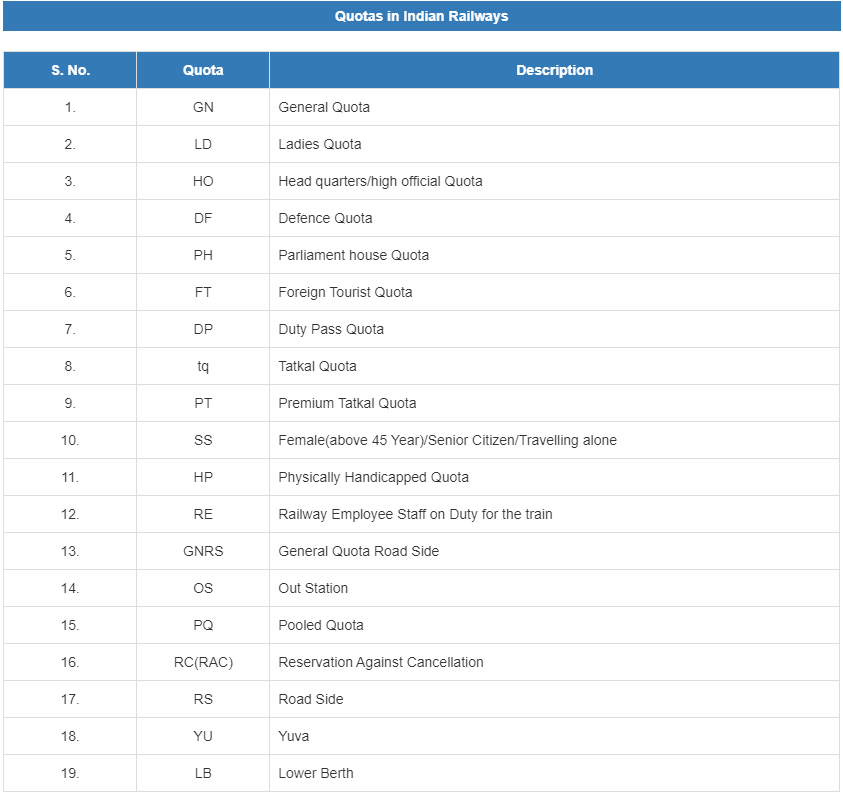
Source – indianrail.gov.in
The 50 % of seats (as depicted in Table 1) that is made available to general public for advance reservation (120 days) comes under GN quota. The remaining 50% of seats is distributed among all the other quotas from serial no 2 to 19 in the above figure.
How many of you knew about all these quotas?
Let me be clear that I am not trying to convey that all these different quotas aren’t useful or should be removed. Instead, all I am trying to point out is that most of the general population, who travels by trains frequently, isn’t even aware of this.
Some of the quotas like Senior Citizen Quota (SS), Ladies Quota (LD), Handicapped Quota (HP) etc are very useful and a necessity for Senior citizens, pregnant ladies, or handicapped travellers. The only requirement is that you should completely understand all these different quotas before booking your tickets. For example, how many of you know that ladies above age of 45 years, travelling alone, have a special quota for them known as SS quota. Even if those ladies aren’t travelling alone, they become eligible for that quota if their ticket is booked independently, in a separate PNR which effectively means that they are travelling alone.
Secondly, refer below table for the same train, Kamayani express, which was discussed above.
| Class | Total Capacity | Tatkal Availability |
| SL (Sleeper Class) | 12 coaches X 80 births per coach = 960 | 216 (23 %) |
| 3A (AC 3 Tier Class) | 4 coaches X 72 births per coach = 288 | 50 (18 %) |
| 2A (AC 2 Tier Class) | 1 coach X 52 births per coach = 52 | 16 (31 %) |
You can see that tatkal quota comprises of almost 25 % of total capacity which means that 25 % of total available seats are unavailable to general public till 1 day before departure of the train.
In case of 2A class, the 120-day availability (11 births) is even lesser than tatkal quota availability (16 births). What does it signify? It means that passengers who plan their journey in advance have a lesser chance of getting a confirmed ticket than those who opt for tatkal ticket 1 day before their journey.
No wonder, there is a huge number of passengers who are waiting till the last moment to get a confirmed seat through tatkal but tatkal booking has its own challenges. Seats get filled in the matter of seconds thanks to illegal software and technologies being used by the touts. In order to have a slimmest chance of successful tatkal booking on your own, you need a good internet connection as a minimum requirement. Just imagine the plight of common people from small town and villages who neither have an internet connection at their disposal nor railway reservation counters nearby. The complex quota system of Indian railways adds to their misery.
In conclusion, the complex quota system of Indian railways limits the knowledge of passengers regarding all the options that are available at their disposal. What is the point of having a separate quota for ladies travelling alone if they aren’t even aware of it? Efforts should be made, by the railways, to educate general public about its complex quota system. 25 % allocation to tatkal quota, which is opened just 1 day before journey, is way too much and it should be reduced to around 10% so that more births are available for advance booking. It will also reduce black marketing of tatkal tickets.
Disclaimer – This blog does not represent the thoughts, intentions, plans or strategies of any organization/employer. It is solely based on my personal knowledge, research and opinion.
 Trainkibaat
Well done dear
LikeLiked by 1 person
Best of luck…!!!
LikeLike