In my last blog (Link), I had postulated that complexity of quota system in Indian Railways is one of the major reasons for common people finding it difficult to get a confirmed ticket. In order to make an informed choice while booking a train ticket, a good understanding of different quotas is a must. There are a total of 19 different quotas that exist as per official website of Railways. In this blog, I will discuss about some of those quotas concisely and I can assure you that after going through this blog, you will be able to book your future tickets much more confidently.
GN (General Quota)
This quota is the most important quota that exists and has maximum allotment of births except in certain classes like 2A (refer the example of Kamayani express in the blog – Link). GN quota is meant for the passengers who reserve their seats from the originating few stations of the train to the last few stations of that train.
For Example – In Geetanjali SF Express (12859/60) which is a very famous train connecting Mumbai to Howrah (Kolkata), if you book your ticket from Mumbai CSMT or Kalyan to Tata /Kharagpur/Howrah, you will be allotted GN quota seats/waitlist.
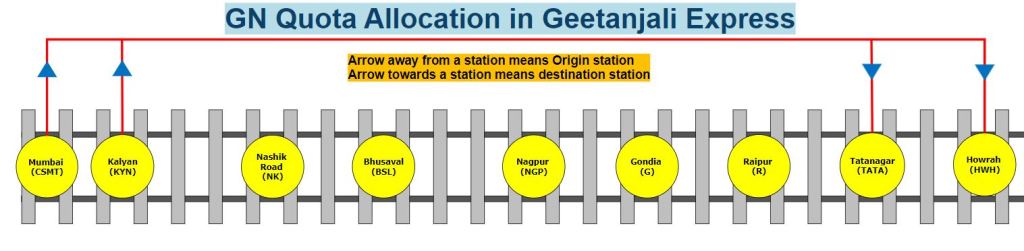
The main advantage of GN quota above all other quotas for general public is that all the empty seats from the originating charting station are first used to clear the waitlist/RAC of GN quota and then transferred to subsequent Remote Location (RL) charting stations.
To fully grasp the significance of the above statement, you must understand that the charting of the GN quota is done at the originating station of the train and while charting, if some of the births are not utilized in the quotas that are not meant for general public (like HO – VIP quota, SS quota etc.), it is first transferred to GN quota to clear the waitlist. Even the unutilized births of Tatkal (TQ) quota (if any) is transferred to clear GN quota first and then PQ and RL quota.
PQ (Pooled Quota)
If you search on the internet, you will find maximum doubts regarding PQ quota. I think it is the most confusing among train-travelers. Pooled quota is allotted for journeys that fall under one of the following two cases:
- From starting few stations of the train as origin to those stations as destination that fall enroute but are not towards the end of the train’s route.
- From enroute few stations of the train as origin to all other stations of the train as destination
For example, in case of Geetanjali Express, Pooled quota is allotted from Mumbai CSMT or Kalyan to Bhusaval/Nagpur/Raipur/Bilaspur. It is also allotted for the journey from Nashik Road/Jalgaon to Nagpur/Raipur/Tatanagar/Kharagpur /Howrah.

Now coming to the most important part – how many births are allotted for pooled quota? This portion is a bit tricky to understand. The allocation of births in pooled quota is not fixed for all OD pairs. It reduces as the distance between origin & destination increases. In the above example of Geetanjali Express, Mumbai CSMT to Nashik Road will have maximum PQ allocation whereas Mumbai CSMT to Raipur/Bilaspur will have least PQ allocation.
I have read at many places that PQ quota waitlist is the hardest to get confirm. This statement is only half correct. In case of Pooled Quota waitlist, the distance between origin and destination becomes very crucial. Larger this distance, lesser are the confirmation chances. Hence if you are travelling in a train that goes from Mumbai to Delhi via Surat – Ratlam – Kota, and you have a PQWL for Mumbai to Surat, it will have high chances of confirmation whereas if you have a PQWL for Mumbai to Kota, it will have a very low chance of confirmation.
Trivia – In case of Pooled quota there is no RAC which means that either your ticket remains waitlisted or it gets fully confirmed. There is no concept of RAC in case of PQ quota.
RL (Remote Location Quota)
When a train starts from its originating station and before it reaches its final destination, it passes through certain important stations from where a good amount of passengers board the train. Its only logical to provide certain amount of births to those passengers and the quota under which these births are provided is known as Remote Location Quota (RL). Important thing to note is that there can be more than one important stations through which the train passes and hence there can be more than one RL quotas.
For Example, in Geetanjali Express, there are 3 RL quotas each for Bhusaval, Nagpur and Gondia stations. For the stations that lie between Bhusaval and Nagpur, RL quota of Bhusaval applies and similarly for stations between Nagpur and Gondia, RL quota of Nagpur applies. In the below figure, only 2 RL quotas (Bhusaval and Nagpur) have been shown for simplicity.

Charting of RL quota of a particular station is done at that station only. For each RL station, some extra births are also allotted for VIP quota and Emergency quota use, which if not utilized, is transferred to its RL quota at the time of charting. When charting for GN quota of a particular train is done at its originating station, if there are certain births that remain unutilized, they are transferred first to the nearest Remote Location charting station enroute. If the first RL quota gets satisfied and still some births are left, they are then transferred to the next RL quota and so on.
In most of the cases, RL quota do not have RAC allocation implying that WLs directly get confirmed without going into RAC. In certain cases where large amount of births are allotted for RL quota, RAC allocation is also done.
RS / RQ (Road Side Quota)
Road Side quota is very similar to Pooled quota (PQ) with one major difference. In case of pooled quota, the allocation is from starting few stations to a series of enroute stations but in case of Road Side quota, the allocation is from originating few stations to a single enroute station.
Example, in case of New Delhi Dibrugarh Rajdhani Express via Samastipur (20504), there is a Road Side quota allotted for Samastipur Jn. which means that there are certain set of seats that are specifically meant for New Delhi to Samastipur passengers.
RS/RQ quota have now become very rare and are only present in a few selected trains.
RAC (Reservation Against Cancellation)
RAC is not a different quota but a special arrangement by railways to accommodate more passengers in limited no of seats. In case of RAC , 2 passengers are allowed to occupy one side-lower birth (lower birth in case of Garib Rath). RAC births usually come under GN quota allocation except in few cases where RL quota also has RAC births. Hence in case of GN quota, if you have a waitlisted ticket, it will first go into RAC and then get confirmed unlike other quotas like PQ or RS. Railways have set maximum limit of RAC allocation in each class as follows :
| Class | Max RAC births per coach | Max RAC passengers per coach |
| SL (Sleeper Class) | 7 | 7 x 2 = 14 |
| 3A (AC III Tier Class) | 4 | 4 x 2 = 8 |
| 2A (AC II Tier Class) | 3 | 3 x 2 = 6 |
All the quotas discussed above are meant for general public and are open for booking 120 days in advance . In the next blog, I will unravel the nitty-gritties of the remaining quotas. I hope that the information shared in this blog will be beneficial for you for your next train travel.
Disclaimer – This blog does not represent the thoughts, intentions, plans or strategies of any organization/employer. It is solely based on my personal knowledge, research and opinion.
 Trainkibaat
One thought on “Deep dive into Indian Railways Quota System (Part 1)”